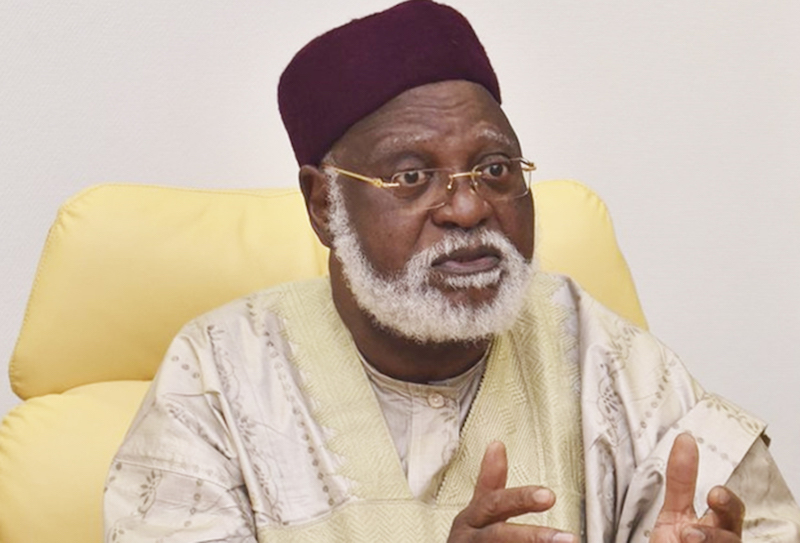
Former Head of State, General Abdulsalami Abubakar, has provided a detailed account of the political and military tensions that followed Nigeria’s 1966 crisis, explaining why Lt. Colonel Emeka Odumegwu Ojukwu refused to recognize Lt. Colonel Yakubu Gowon as head of state after the assassination of Major General Johnson Aguiyi-Ironsi.
The account appears in Abubakar’s autobiography, *Call of Duty*, which was presented in Abuja during his 84th birthday celebration. He traced the dispute to disagreements over military succession and rising mistrust within the armed forces following the counter-coup of July 1966.
Abubakar explained that Ojukwu rejected Gowon’s emergence on the grounds of military hierarchy, insisting that another senior officer should have taken over. According to him, Ojukwu maintained that in the absence of Aguiyi-Ironsi, the next in command should have been Brigadier Babafemi Ogundipe.
He wrote: “Lt. Colonel Emeka Odumegwu Ojukwu, the Governor of the Eastern Region, refused to recognise the new head of state, insisting that in the absence or death of Aguiyi-Ironsi, the next in command was Brigadier Babafemi Ogundipe, the Chief of Staff, Supreme Headquarters.”
Abubakar added that the refusal to accept Gowon’s leadership came at a time when ethnic tensions were already escalating across the country. He recalled that “anti-Igbo sentiments exploded in the North,” leading to killings and widespread displacement, while retaliatory violence also spread in parts of the East.
He further stated that repeated attempts to resolve the crisis failed, including major negotiations aimed at preserving national unity. “All efforts to prevent secession failed… A political solution was not looking likely,” he noted, adding that the breakdown in trust made compromise increasingly difficult.
The former leader also described the moment that led to the declaration of Biafra on 30 May 1967. “On 30 May 1967, Ojukwu announced that Igbos would leave Nigeria for good to form their own country… He declared the Republic of Biafra,” he wrote.
According to Abubakar, the federal government under Gowon remained committed to national unity, insisting that “to keep Nigeria one is a task that must be done,” a phrase that later became associated with his name.
Reflecting on the conflict decades later, Abubakar said the war might have been avoided if tensions had been managed differently. “To this day, I believe that the Civil War, like most other conflicts in life, could have been prevented,” he said, noting that anger and reprisals deepened the crisis.
He also recounted a military setback during operations in the East, describing a situation after the capture of Onitsha when federal forces suffered heavy losses. He said the assumption that the war was nearing an end led to a tactical error that exposed troops to a counterattack involving rocket fire and explosions that destroyed vehicles and fuel supplies.
Abubakar concluded that despite the scale of destruction, Nigeria eventually remained united, adding that lessons from the conflict should guide future generations in avoiding a repeat of such a war.