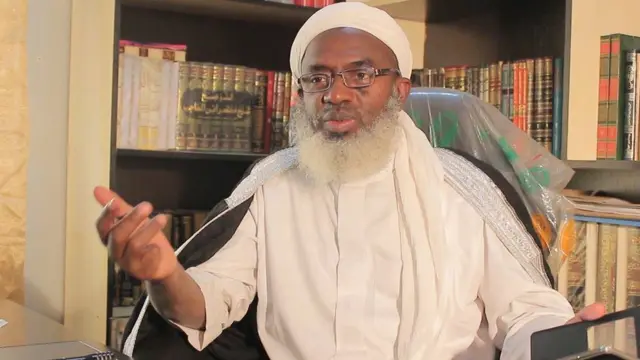
A Nigerian Islamic cleric, Sheikh Ahmad Gumi, has raised concerns over the involvement of United States forces in a joint military operation that led to the killing of Abu-Bilal al-Minuki, a senior Islamic State commander in Nigeria.
The operation, carried out in collaboration with the Nigerian Armed Forces, was confirmed by the Defence Headquarters in Abuja and described as a coordinated counterterrorism mission targeting a high-ranking ISIS figure linked to regional extremist networks.
Reacting to the development in a Facebook post on Saturday, Gumi said the fight against terrorism is necessary but argued that it must be conducted without the involvement of actors he accused of moral wrongdoing in other conflicts.
“It’s a religious obligation to annihilate terrorists, but not with Beelzebub and hands stained with the blood of innocent men, women, and children,” he wrote.
His remarks appeared to question the role and credibility of foreign military partners involved in the operation, even as he acknowledged the need to confront armed extremist groups.
The comments followed an announcement attributed to United States President Donald Trump, who said US forces, working alongside Nigerian troops, carried out a “meticulously planned and very complex mission” that resulted in the death of al-Minuki.
Nigeria’s Defence Headquarters also confirmed the killing, stating that the operation eliminated a key ISIS coordinator responsible for directing activities across West Africa and the Sahel region.
In a statement issued by Major General Samaila Uba, the military described al-Minuki as a strategic figure within ISIS who was involved in propaganda operations, weapons development, and the adoption of drone technology for militant use.
“His death removes a critical node through which ISIS coordinated and directed operations across different regions of the world,” the military said.
Authorities further alleged that al-Minuki had previously been linked to Boko Haram before pledging allegiance to ISIS in 2015, and later became involved in several high-profile attacks, including the 2018 abduction of schoolgirls in Dapchi, Yobe State.
The Defence Headquarters added that intelligence suggested he may have recently risen to a senior leadership position within the global ISIS hierarchy before being eliminated in the joint operation.
Officials described the development as a significant setback for extremist networks operating in Nigeria and across the wider Lake Chad Basin.