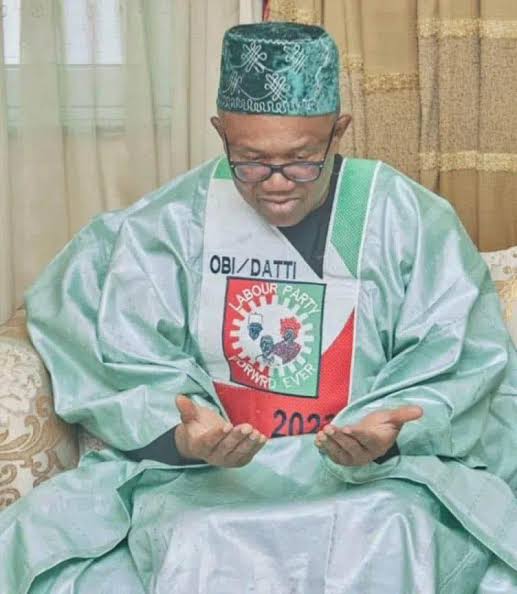
Political opinion across Northern Nigeria appears sharply divided over the renewed promise by the presidential hopeful of the National Democratic Congress (NDC), Mr Peter Obi, to serve only one term if elected president in 2027, with many stakeholders describing the proposal as politically strategic but lacking enforceable guarantees.
Obi recently reiterated that he would serve only one four-year term if elected president “even at gun point,” presenting the proposal as a stabilising arrangement intended to reassure northern political interests and preserve the country’s rotational balance.
He made the promise after NDC zoned the top office to the South of the country and the vice president to the North after he had defected from the African Democratic Congress (ADC).
The development clearly favours him and Senator Rabiu Musa Kwankwaso, a northern from Kano State, who is expected to run with him as VP.
However, conversations across political circles in the North indicate that the dominant reaction remains cautious engagement rather than outright acceptance.
Many northern politicians, analysts and opinion leaders interpret the proposal as an electoral strategy aimed at improving Obi’s acceptability in the region at a time when opposition alliances are being recalibrated ahead of 2027.
The promise is widely viewed as part of a broader effort to secure northern backing for a possible political arrangement involving influential northern political figures.
Unwritten arrangements
A major concern repeatedly raised by northern stakeholders is the issue of trust. Several politicians interviewed referenced developments that followed the death of former President Umaru Musa Yar’Adua in 2010 and the subsequent decision by former President Goodluck Jonathan to contest for another term in 2011.
For many northern politicians, that episode remains a defining moment that shaped the region’s scepticism toward informal zoning arrangements and unwritten political understandings.
Many northern figures within the ruling All Progressives Congress argue that Obi’s promise cannot override constitutional provisions.
According to them, the Nigerian Constitution permits a president to seek re-election after completing a first term, regardless of campaign assurances made before assuming office. They insist that once incumbency comes into play, political calculations often change.
Electoral sympathy
Political analyst and youth leader, Murtala Abubakar, described Obi’s one-term pledge as “a political gimmick designed to secure electoral sympathy.” According to him, the promise lacks legal and moral binding force because no constitutional mechanism exists to compel compliance once a president is elected.
He argued that the North has become increasingly cautious after what many perceived as the collapse of the zoning understanding during Jonathan’s administration.
According to Abubakar, northern voters are now more interested in constitutional certainty than verbal assurances.
“What we seek is not a temporary placeholder arrangement, but leadership that respects fairness and demonstrates genuine commitment to power rotation,” he said.
Political covenant
His position reflects a broader sentiment among conservative northern political blocs that view the proposal as an electoral tactic rather than a dependable political covenant.
Similarly, National President of the Northern Youth Council of Nigeria, Isah Abubakar, said the North now approaches such promises with a “once bitten, twice shy” mentality.
He argued that memories of the 2011 political transition remain fresh among many northerners who believe the region was politically disadvantaged after Yar’Adua’s death.
According to him, the major weakness of Obi’s proposal lies in the contradiction between constitutional reality and verbal political promises.
He noted that once sworn into office, a president possesses the constitutional right to seek another term, while powerful political interests surrounding the presidency could pressure the incumbent to remain in office beyond the initial pledge.
In his view, accepting a four-year “bridge presidency” without constitutional safeguards could expose the region to uncertainty if the promise is eventually abandoned after incumbency is consolidated.
Pathway to power
Within the North-West, particularly among supporters of Kwankwaso, opinions also appear divided.
Some Kwankwasiyya loyalists reportedly see the arrangement as a possible pathway toward reclaiming presidential power in 2031 through a negotiated alliance structure.
Others, however, fear that the advantages of incumbency could ultimately weaken northern bargaining power once a southern administration becomes fully entrenched.
Chairman of Northern Star Youths Employment Initiative and National President of APC 19 Northern States Support Groups, Dr. Maina Gimba, offered a more measured position.
While acknowledging Obi’s growing grassroots outreach in parts of the North, including Kaduna and Katsina states, he argued that the success or failure of such an arrangement would depend on broader political negotiations, including the identity of Obi’s running mate and the specific terms northern stakeholders may demand as part of any alliance.
Gimba also suggested that many northern politicians remain cautious about Obi’s long-term political intentions.
According to him, northern political actors are closely studying Obi’s movements and motives before making any firm commitments ahead of the 2027 election.
From within the APC, Bala Ibrahim dismissed the proposal entirely, insisting that Nigerians should be wary of the promise because “the Constitution precedes all other promises.”
He argued that political advisers and supporters could eventually persuade Obi to exercise his constitutional right to seek re-election if elected president.
Political deception
According to him, the ruling party is not threatened by Obi’s growing political activities but considers it necessary to alert voters against what he described as possible political deception.
A chieftain of the ADC, Faisal Kabir, also expressed doubts about the credibility of the one-term promise, arguing that many Nigerians remain sceptical of political pledges generally.
However, Obi supporter, Ibrahim Hussaini Abdulkarin, countered that while politicians are often accused of dishonesty, there should be room for exceptions. He maintained that Obi has demonstrated consistency in keeping political promises in the past and would honour the one-term commitment if elected.
Also weighing in, Dr. Muhammad Hamisu, Kano State Coordinator of Kwankwasiyya Diaspora, expressed confidence in Obi’s pledge. According to him, many northerners believe Obi is a politician who would honour his commitment to serve only one term if elected.
“We Northerners believe in his promise to serve only one term. We remain optimistic because we believe Peter Obi is a man of integrity who will keep his promise. We firmly believe that progress and prosperity can only thrive where there is justice, fairness, unity and inclusion, values that a Peter Obi and Kwankwaso ticket represents,” he said.
Analysts, however, say the ultimate success of the proposal may depend less on the promise itself and more on whether influential northern political heavyweights eventually endorse and legitimise the arrangement ahead of the next year’s presidential election.